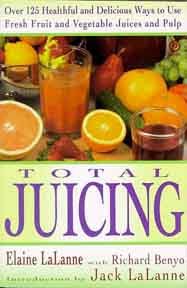
 Total Juicing: The Complete Guide to Healthy and Delicious Fresh Fruit and Vegetable Juices by Elaine La Lanne, Richard Benyo, and Jack Lalanne Features & SpecificationsJuicing For Life Book - a review of the health benefits of juicing fresh fruit and veggies Total Juicing: The Complete Guide to Healthy and Delicious Fresh Fruit and Vegetable JuicesBy: Elaine LaLanne, Richard Benyo, and Jack LaLanneJUICE YOUR WAY TO HEALTH...EVEN HELP PREVENT CANCERAcross America, millions of people are discovering juicing as an easy, inexpensive, and delicious way to enjoy tremendous health and nutritional benefits. Today's new juice extractors have opened up an exciting avenue to taking control over your own health and well-being. Elaine and Jack LaLanne, who have been juicing for thirty years, discovered that fresh fruit and vegetable juices, and the fiber-rich pulp that the juicer yields, have excellent benefits when used in combination with a healthful diet. Now you can learn how to control weight and lower blood pressure, address such conditions as psoriasis, stomach ulcers, arthritis, anemia, and gout, and even help prevent cancer- all in your own kitchen. Total Juicing provides up-to-date information and more than 125 recipes for great juice combinations and for fruit and vegetable pulp. You'll find:An A-to-Z guide to juicing directions, vitamin and mineral content of fruits and vegetables, and health benefits of specific foods A weight-loss program that works-with fresh juicesThe dos and don'ts of making and storing juice Baby-food recipes from the juicer Terrific original recipes for breakfast drinks, lunchtime refershers, dinner beverages, flavorful desserts and bartender's tips as well Great recipe ideas for fiber-rich pulp 240 Pages
Sausage and mash is considered one of the best English dishes. Whatever your budget, there is a sausage out there that you can afford, that will taste delicious and that can be utilised in many ways to serve up as a reasonably impressive dish for guests or simply as an everyday meal or snack.
Sausages made from premium cuts of meat are mixed with rare spices and a degree of fat and fashioned into the typical sausage shape for those with plenty of money but if you're not wealthy then you can pop into any supermarket and pick up a packet of sausages. Sometimes the meat content is dubious and it has always been assumed that sausages are made up of the dregs of an animal that can't be used for any other purpose. But this isn't always so and manufacturers are making more effort these days to fill sausages with better quality meat.
Sausages with vegetables, Yorkshire puddings and gravy, sausage and mash with liquor, sausage and chips or sausage and chips, even vegetarian sausages - mix it up any way you like but there will be a sausage to suit.
Nowadays, we have food processing equipment that makes the whole sausage making procedure swift and easy. Meat is automatically ground down to the correct consistency, mixed with fillers, spices and fat and fed through into skins and they are even divided into 'links' by the same machine. But it hasn't always been like this.
Sausages are not a modern food. Records date back to 500bc of kitchens that produced sausages in one form or another. People took great care in the mixing of special spices and the rarer the spice the better the sausage was considered to be. Of course, back then food processing equipment consisted of butchers who would create everything from the sausage skin to stuffing methods and sausage making became quite an art.
Early American colonies were fond of sausages because meat was an expensive commodity and they were instructed to use every part of the animal except the snout. To do this, they would use up the intestines, bladders, uterus, stomach and all parts of the pig to grind down, mix with spice and then cover with a layer of melted fat. This produced a sausage that could then be smoked and thus preserved, lasting for quite some time in cold cellars and providing family food for months.
Smoked sausages were also a favourite with soldiers. These were one of the few foods that they could be sure wouldn't go off too quickly and would provide, in their basic form, a pretty good source of sustenance. They would also have taken black pudding, which is a form of sausage made from pigs blood and this is still a popular dish today, proving further that no part of an animal is wasted.
Over the years, people have found ways round the fact that food processing equipment had yet to be invented. Sausage fillers were made from funnel shaped objects and these made the whole process a little easier as the less handling of the delicate sausage skins, the better. One of the most frustrating things about making a sausage would have been the splitting of the skin whilst filling as this skin not only acted as a way of holding the contents together but would also have been used as a preservative.
So, whatever the method, whatever the animal part, whatever the spice and whatever the price, there is a way for everybody to enjoy sausages.
Culinary expert Catherine Harvey looks at how sausage making is so much easier with the use of food processing equipment and how they did it in the early days.
dehydrator